
Grain · 한국 전통 뷰티 성분 백과사전
쌀ssal
Rice
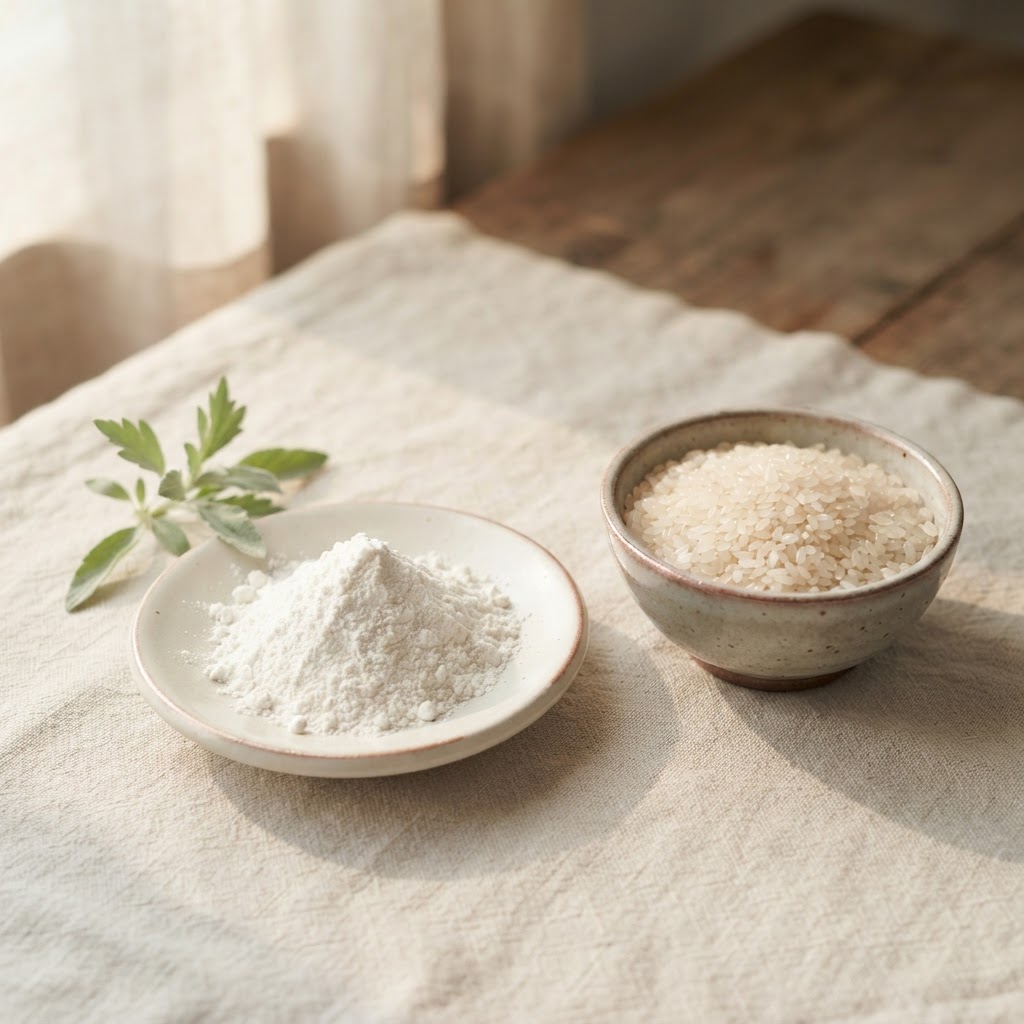
The grain at the centre of Korean daily life, and the source of rice-derived cosmetic ingredients.
Scientific identification
Oryza sativa
INCI name: Oryza Sativa (Rice) Extract
Korean heritage ingredient
This classification records the context the ingredient is documented in, not where it comes from: a Korean heritage ingredient is one with documented use in Korean practice, while a modern cosmetic ingredient carries no heritage claim. Neither label states that the ingredient originated in Korea.
Skin concerns this profile is offered for
A browsing aid and a statement of cosmetic intent only: it diagnoses nothing and promises no result.
Korean Heritage
Rice has been central to Korean daily life and food culture for centuries, and it carries a long association with washing, cleansing and household beauty practice. Rice washing water was commonly kept at home, which is why rice remains one of the most familiar ingredients in Korean beauty tradition.
Traditional uses
- Rice washing water kept at home for washing and skin care
- Polished rice flour used as a mild household cleansing powder
References
- Oryza Sativa (Rice) Extract — labelling name and declared cosmetic function · European Commission CosIng cosmetic ingredient database · https://ec.europa.eu/growth/tools-databases/cosing/
- The cosmetic safety and claims framework this profile is written under · Regulation (EC) No 1223/2009 on cosmetic products, consolidated text · https://eur-lex.europa.eu/eli/reg/2009/1223/oj
- Rice as the Korean staple grain, and the recorded household use of rice water in Korean beauty practice · Korean Culture and Information Service (Korea.net) — Korean food and daily-life culture · https://www.korea.net/
- Identified rice constituent gamma-oryzanol and its chemical record · PubChem compound database, US National Library of Medicine · https://pubchem.ncbi.nlm.nih.gov/#query=gamma-oryzanol
- Indexed literature on rice-derived ingredients and skin — the basis for the ratings shown here, not proof of an outcome · PubMed, US National Library of Medicine · https://pubmed.ncbi.nlm.nih.gov/?term=Oryza%20sativa%20rice%20extract%20skin
Modern Cosmetic Science
Modern cosmetic applications
- Rice extract and rice water are used as skin-conditioning ingredients in toners, essences and creams
- Rice starch and rice-derived powders appear in cleansing and mask formulations
Rice-derived ingredients are widely used in cosmetic formulation and appear in published reviews of plant ingredients used on the skin. Studies on rice extract or fermented rice ingredients are mostly laboratory work or small cosmetic trials measuring hydration and skin feel rather than long-term change, and they do not test a homemade rice water preparation.
Benefits & Limitations
Evidence by claim
Every rating applies to ONE claimed benefit. An ingredient is never given a single overall effectiveness score.
Skin-conditioning support in a cosmetic formulation
TraditionalRating approved by an authorized reviewerRating reviewed: the traditional use is documented while direct clinical evidence for this claim is limited, which is what this rating records.
Moisturizing support in a formulated product
TraditionalRating approved by an authorized reviewerRating reviewed: the traditional use is documented while direct clinical evidence for this claim is limited, which is what this rating records.
A softer feel to the skin after cosmetic use
TraditionalRating approved by an authorized reviewerRating reviewed: the traditional use is documented while direct clinical evidence for this claim is limited, which is what this rating records.
What is not claimed
Laboratory work on rice-derived ingredients does not establish that homemade rice water has clinically proven anti-aging effects, and no such claim is made here.
Safety & Allergies
- Rice is a known food allergen. A rice allergy or a rice sensitivity must be taken seriously, and a product that provokes a reaction should be stopped
- Rice-derived cosmetic ingredients are generally well tolerated; patch-test a new product as usual
Allergens this recipe can carryRice
Related Beauty Rituals
Related beauty rituals are being reviewed.
Professionally formulated products
No professionally formulated product is listed for this ingredient yet.
Rice has a documented place in Korean food culture and in household cleansing practice. That cultural association is not evidence that a rice preparation produces a measured change in the skin.
Related ingredients
Grain
율무
Job's Tears
The bead-like grain used in East Asian food and herbal traditions, and in some skincare products.
Dryness and dehydration · Rough texture and pores
ExploreHerb
연꽃
Lotus
A plant woven through Korean culture and cooking, whose flower, leaf and root are now also used in modern Korean skincare.
Dryness and dehydration · Rough texture and pores
ExploreGrain
보리
Barley
The grain of Korean agriculture and everyday cooking, and a source of barley-derived cosmetic ingredients.
Dryness and dehydration · Barrier support
ExploreRelated by the concerns and category they share. This is not a ranking and not a recommendation from your own assessment.