Lipid · 한국 전통 뷰티 성분 백과사전
시어버터sieobeoteo
Shea Butter
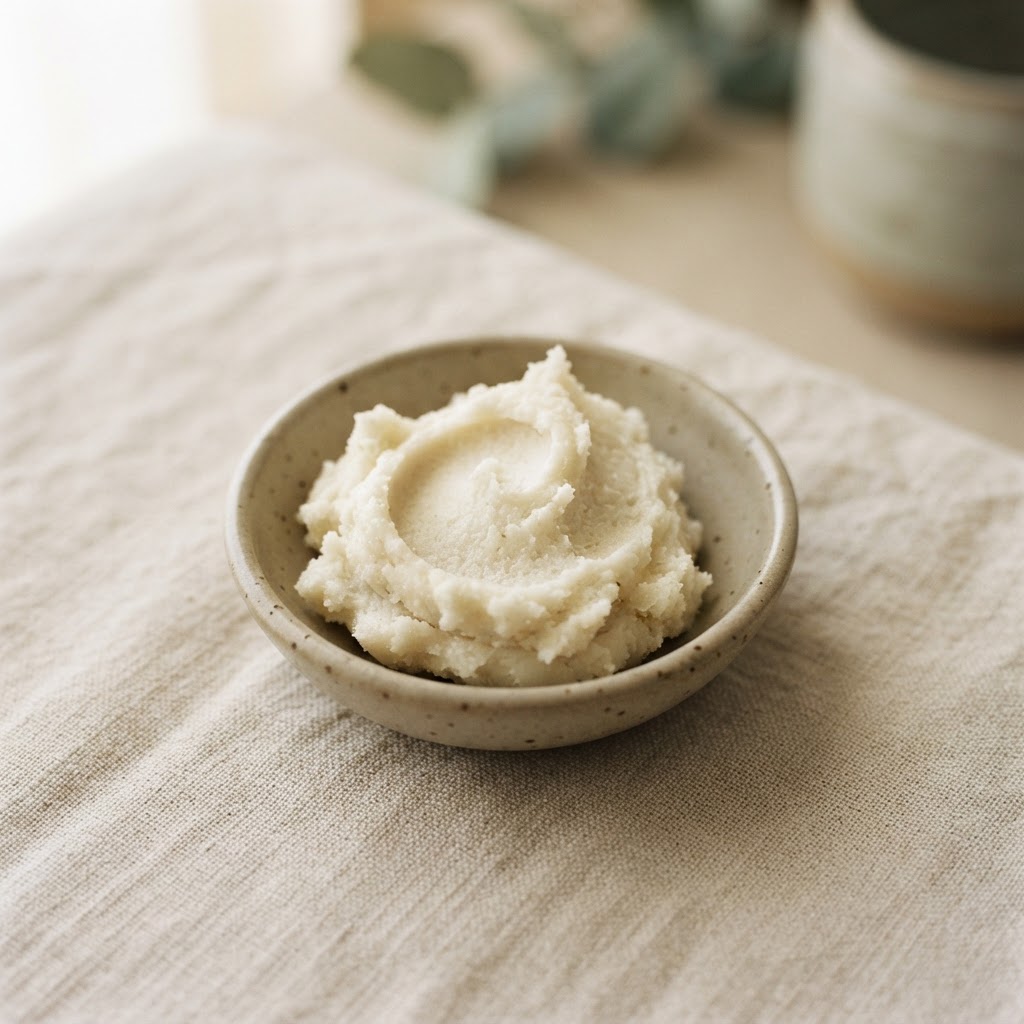
A rich plant butter that is one of the best characterised emollients, widely used in creams and balms, and best understood as a softening and water-loss-limiting material rather than a treatment.
Scientific identification
Vitellaria paradoxa C.F.Gaertn.
How to read this identification: The INCI name uses the older genus name Butyrospermum parkii, though the tree is now classified as Vitellaria paradoxa. Refined and unrefined shea butter differ: unrefined material keeps more of its colour and scent and more of its unsaponifiable fraction, so two products declaring Shea Butter are not necessarily the same material.
INCI name: Butyrospermum Parkii (Shea) Butter
Modern cosmetic ingredient
This classification records the context the ingredient is documented in, not where it comes from: a Korean heritage ingredient is one with documented use in Korean practice, while a modern cosmetic ingredient carries no heritage claim. Neither label states that the ingredient originated in Korea.
Skin concerns this profile is offered for
A browsing aid and a statement of cosmetic intent only: it diagnoses nothing and promises no result.
Modern cosmetic context
Shea butter is a modern cosmetic ingredient and carries no Korean heritage claim. It is included because it is common in contemporary formulation, including Korean creams, sleeping masks, body butters and balms. Shea is a traditional material in West African food and skin practice, and that is recorded honestly here, but it is not a Korean heritage material and this profile does not place it in the Korean tradition. Its place in this encyclopedia is modern formulation.
References
- Review literature on shea butter in cosmetic formulations and its emollient behaviour · Published cosmetic science review literature on shea butter
- Composition literature on shea kernel fat and its unsaponifiable fraction · Published lipid and food science literature on Vitellaria paradoxa
Modern Cosmetic Science
Modern cosmetic applications
- Used in creams, sleeping masks, body butters, balms and lip products, often as the main emollient
- Chosen to soften and to reduce water loss at the surface, and usually combined with a humectant so the water held in the skin is not lost to dry air
Shea butter is a characterised emollient: a fat rich in stearic and oleic acids with an unsaponifiable fraction, and its softening function in a formula is established. It forms a film that reduces water loss from the surface, and cosmetic studies describe improved measured hydration and reduced water loss after shea-containing products, which supports a promising position on moisturising and barrier support rather than an established one. No evidence establishes a change in the skin beneath the surface.
Benefits & Limitations
Evidence by claim
Every rating applies to ONE claimed benefit. An ingredient is never given a single overall effectiveness score.
Emollient softening of the skin in a cosmetic formulation
EstablishedRating approved by an authorized reviewerRated established: this is the material's characterised cosmetic function and relevant human evidence supports this specific claim. Claim: Emollient softening of the skin in a cosmetic formulation
Moisturizing support in a formulated product
PromisingRating approved by an authorized reviewerRated promising: preliminary or composition-level evidence exists for this specific claim, and the rating does not extend beyond it. Claim: Moisturizing support in a formulated product
Reduced water loss from the skin surface in a cosmetic formulation
PromisingRating approved by an authorized reviewerRated promising: preliminary or composition-level evidence exists for this specific claim, and the rating does not extend beyond it. Claim: Reduced water loss from the skin surface in a cosmetic formulation
What is not claimed
No claim is made that shea butter repairs skin, heals scars or stretch marks, treats eczema or any skin condition, or gives firmness. Softening the surface and reducing water loss are not the same as changing the skin beneath, and a rich butter is not a treatment for a diagnosed condition.
Safety & Allergies
- Shea butter is generally very well tolerated, and allergy to it is uncommon; it is tree-derived (from the Sapotaceae family) and a rare allergy to its kernel proteins has been reported, so anyone with a known tree-nut allergy should ask their clinician before using it
- A rich butter can feel heavy and may not suit oily or blemish-prone skin; unrefined shea has a strong nutty scent, which some users prefer to avoid on the face
Related Beauty Rituals
No related beauty ritual is recorded for this ingredient yet.
Professionally formulated products
No professionally formulated product is listed for this ingredient yet.
This is a modern cosmetic ingredient. No traditional or cultural association is recorded for it, and none is claimed.
Related ingredients
Lipid
세라마이드
Ceramides
Skin-identical barrier lipids and the best-evidenced barrier ingredient class in modern formulation, usually presented in a lipid blend rather than alone.
Dryness and dehydration · Barrier support
ExploreVitamin
판테놀
Panthenol
Provitamin B5, a well-established moisturising and calming ingredient that appears throughout contemporary Korean skincare.
Dryness and dehydration · Barrier support
ExploreHumectant
글리세린
Glycerin
The most widely used humectant in cosmetics and one of the best characterised: it binds water, and its moisturising role is established rather than promised.
Dryness and dehydration · Barrier support
ExploreRelated by the concerns and category they share. This is not a ranking and not a recommendation from your own assessment.