Tea · 한국 전통 뷰티 성분 백과사전
뽕잎ppongip
Mulberry Leaf
A Korean tea and food leaf whose constituents are being investigated for tone-related cosmetic application, recorded for its documented cultural place rather than as an established lightening ingredient.
Scientific identification
Morus alba L.
How to read this identification: The leaf is the labelled material. Mulberry root bark and mulberry fruit are different parts, recorded traditionally under different names and with different composition, so a leaf extract is not interchangeable with either of them.
INCI name: Morus Alba Leaf Extract
Korean heritage ingredient
This classification records the context the ingredient is documented in, not where it comes from: a Korean heritage ingredient is one with documented use in Korean practice, while a modern cosmetic ingredient carries no heritage claim. Neither label states that the ingredient originated in Korea.
Skin concerns this profile is offered for
A browsing aid and a statement of cosmetic intent only: it diagnoses nothing and promises no result.
Korean Heritage
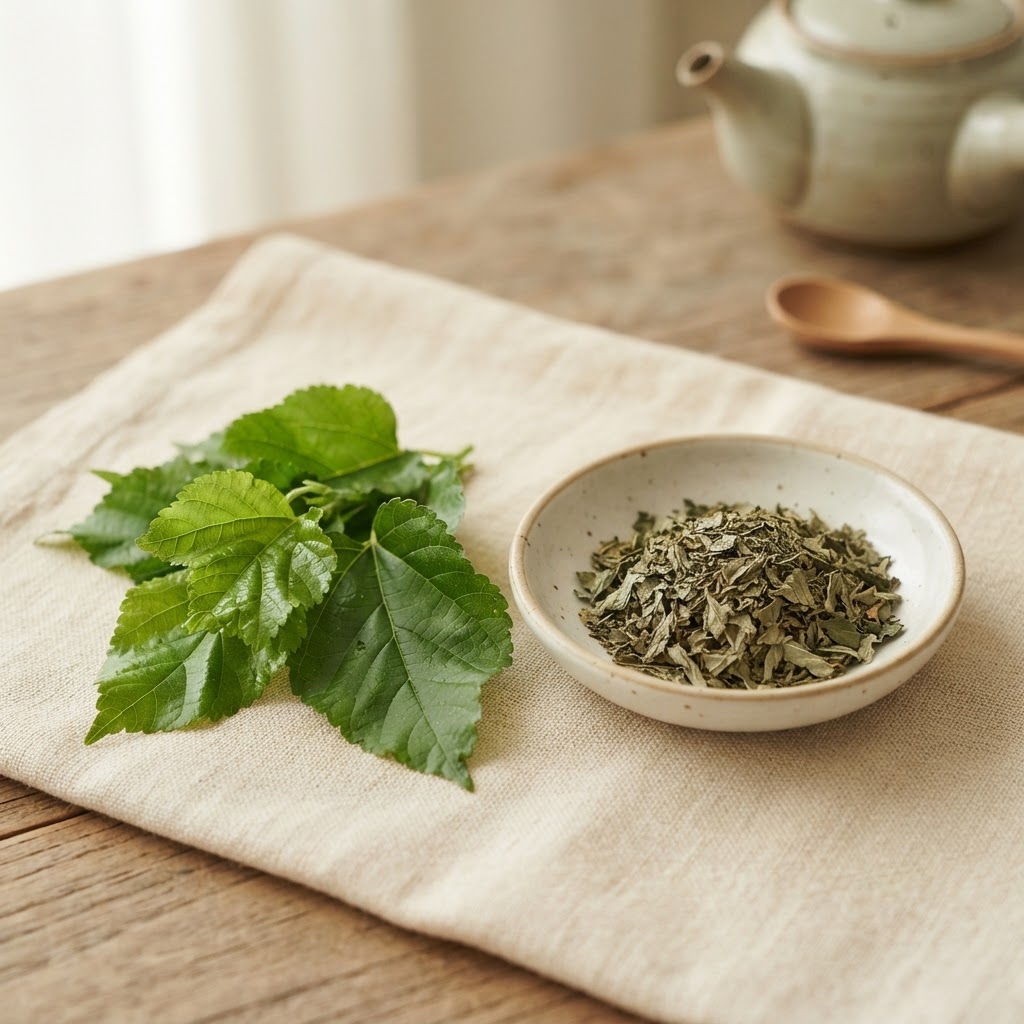
Mulberry leaf has a long recorded place in Korean daily life. The leaf is prepared as a tea, used in food, and its cultivation is bound up with Korea's long history of sericulture, so the tree and its leaves carry a documented place in Korean rural and household practice. This encyclopedia records that place as cultural context. It does not present mulberry leaf as a lightening ingredient: the traditional association and the laboratory work on its constituents are separate things, and neither establishes a result on skin.
Traditional uses
- Prepared as a leaf tea and used in food in Korean household practice
- Recorded in rural and household practice alongside Korea's sericulture tradition, noted here as tradition rather than as an established effect
References
- Recorded use of mulberry leaf in Korean tea, food and household practice · Documented Korean food and household practice
- Literature on mulberry leaf constituents and the enzyme inhibition investigated for them · Published phytochemistry literature on Morus alba
Modern Cosmetic Science
Modern cosmetic applications
- Used as a leaf extract in Korean toners, essences and creams, often in tone-focused lines
- Included in botanical brightening blends, where it sits with other extracts rather than acting alone
Mulberry leaf contains flavonoids and other polyphenols, and extracts have been studied in laboratory work for the inhibition of tyrosinase, the enzyme involved in pigment formation, with some cosmetic studies on tone. That work is mostly on extracts in a dish, and tyrosinase inhibition in a laboratory is not a demonstrated lightening result on a person, which is why the tone position is promising rather than established. The antioxidant position is rated promising on the same composition and laboratory basis, and the oiliness claim is rated experimental because the sebum-related evidence is thin.
Benefits & Limitations
Evidence by claim
Every rating applies to ONE claimed benefit. An ingredient is never given a single overall effectiveness score.
A cosmetic focus on the look of uneven tone and dark spots
PromisingRating approved by an authorized reviewerRated promising: preliminary or composition-level evidence exists for this specific claim, and the rating does not extend beyond it. Claim: A cosmetic focus on the look of uneven tone and dark spots
Antioxidant focus in a cosmetic formulation
PromisingRating approved by an authorized reviewerRated promising: preliminary or composition-level evidence exists for this specific claim, and the rating does not extend beyond it. Claim: Antioxidant focus in a cosmetic formulation
A cosmetic focus on the look of oily-feeling skin
ExperimentalRating approved by an authorized reviewerRated experimental: evidence for this claim is insufficient, so it is stated as a cosmetic focus or expectation only. Claim: A cosmetic focus on the look of oily-feeling skin
What is not claimed
No claim is made that mulberry leaf lightens skin, removes dark spots, treats melasma or pigmentation disorders, or controls oil production. Laboratory enzyme inhibition is not a clinical outcome, and nothing here should be used instead of sun protection or a prescribed treatment.
Safety & Allergies
- No cosmetic allergen is established for mulberry leaf extract, but allergy to mulberry leaf and to related Moraceae pollen has been reported
- If you have a known plant or pollen allergy, patch-test a new product on a small area before using it on the face
Related Beauty Rituals
No related beauty ritual is recorded for this ingredient yet.
Professionally formulated products
No professionally formulated product is listed for this ingredient yet.
Mulberry leaf has a documented place in Korean tea, food and household practice. Traditional use is recorded here as association and documented practice, never as evidence of a cosmetic or clinical effect.
Related ingredients
Tea
녹차
Green Tea
The tea leaf of Korean daily life, and a studied antioxidant cosmetic ingredient.
Sensitive-feeling skin and visible redness · Uneven tone and dark spots
ExploreTea
유자
Yuja (Citron)
A Korean citrus used for tea and household preparations, with a documented culinary tradition and a real handling caution because its peel oils can photosensitise skin.
Dryness and dehydration · Uneven tone and dark spots
ExploreHerb
감초
Licorice Root
The root used in Korean herbal medicine, and the source of licorice-derived cosmetic ingredients.
Sensitive-feeling skin and visible redness · Uneven tone and dark spots
ExploreRelated by the concerns and category they share. This is not a ranking and not a recommendation from your own assessment.